
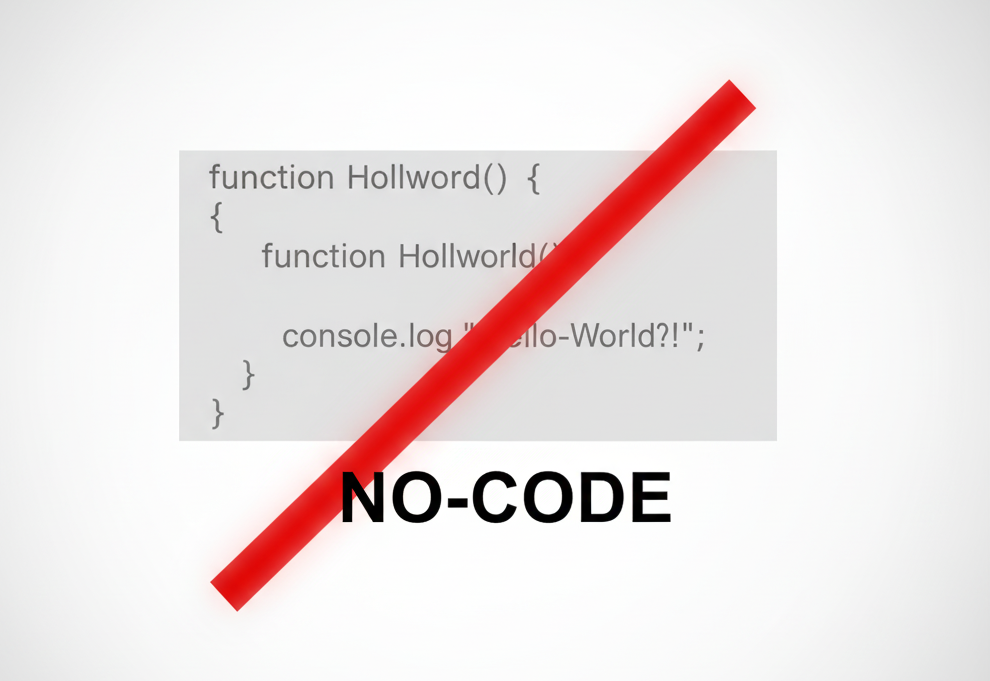
Introduction: A Seismic Shift
Imagine a marketing manager at a Lagos fintech startup who just built a customer onboarding system that handles 1,000 applications daily without knowing how to code. Or think about an operations manager in Nairobi who created an inventory system that saved his company $200,000 a year—also without coding knowledge. These aren’t rare exceptions anymore. This is the no-code revolution, and it’s fundamentally changing who gets to build software.
According to research firm Gartner, 70% of new applications will be built by everyday business people rather than professional developers by 2025. The market for these no-code tools is expected to reach $45.5 billion by 2027. This isn’t just another tech trend—it’s a complete reimagining of software development.
What Is No-Code Development?
No-code platforms let you create fully functional applications by prompting or dragging and dropping visual components, similar to assembling digital LEGO blocks. Instead of learning programming languages like Python or Java over several years, you work with pre-built templates and components that millions of users have already tested. Many platforms now use artificial intelligence to suggest workflows automatically, and you can deploy your finished application to powerful cloud servers with a single click.
The difference from traditional coding is dramatic. Your finance team can now build budget tracking systems. Your sales team can create lead qualification workflows. Your HR department can develop employee wellness apps. No specialized training required—just business knowledge and common sense.
No-Code vs. Low-Code vs. Traditional Coding: Understanding the Difference
The spectrum of development approaches varies mainly in the amount of technical knowledge required and the speed at which you can build things. No-code requires no technical skills and lets you build applications in hours to days, though it has moderate customization limits. Low-code requires basic technical understanding and takes days to weeks, offering higher customization but at a higher cost. Traditional coding demands advanced technical skills, takes months or years, but offers unlimited customization. Your choice depends on what you’re building and your budget—no-code typically costs $20 to $500 per month, while traditional development costs $10,000 or more just to get started.
Why Major Companies Are Switching to No-Code
Speed That Changes Everything
The difference in development time is staggering. What traditionally takes 6 to 18 months can now be built in 2 to 6 weeks. Unilever, one of the world’s largest consumer goods companies, reduced its app development time by 90% and launched over 400 applications in just 18 months using no-code platforms. Their traditional IT department would have needed a decade to accomplish the same thing.
Cutting Costs Dramatically
A professional developer in the United States earns around $107,000 per year, while African developer salaries vary widely, often between $7,000 and $55,000, depending on location and seniority. A no-code platform subscription costs $240 to $6,000 per year. Most companies recoup their investment within 3 to 6 months.
The Ability to Adapt Instantly
With traditional software, changes require months of planning and development cycles. With no-code platforms, you can update features the same day based on customer feedback. You can test different approaches with real users immediately. When market conditions shift unexpectedly, you can pivot without delay. The people using the system, not distant IT teams, can continuously improve it.
The Main No-Code Tools Available Today
For Websites and Online Stores: Webflow has 3.5 million users and powers websites that attract over 100 million visitors monthly, with built-in SEO. Shopify processes about 10% of all U.S. online shopping and handled $11.5 billion in sales during Black Friday alone.
For Building Apps: Bubble has been used to create 6 million applications and handles over 2 billion data requests monthly, serving everyone from startups to government agencies. FlutterFlow lets you build apps that work on both iPhones and Android phones and can be published directly to app stores.
For Automating Routine Tasks, Zapier connects over 7,000 different business applications and has helped 2.2 million businesses automate 2 billion tasks monthly. Users report saving about 10 hours per week. Make (formerly Integromat) offers more advanced automation for complex scenarios and can transform data across different systems.
For Managing Data, Airtable combines the simplicity of a spreadsheet with the power of a database and is used by over 450,000 organizations, including Netflix for content planning and Shopify for inventory management. Xano lets you build the backend infrastructure that powers applications without writing code and can handle millions of records.
For Internal Business Tools: Retool lets companies build administrative tools 10 times faster and is used by companies like Amazon, DoorDash, and NBC to connect to their existing databases and systems.
Fundamental Limitations You Should Know About
No-code isn’t magic; it has boundaries. Most platforms struggle when you need to support more than 100,000 users at the same time, though a hybrid approach—starting with no-code for rapid prototyping, then optimizing with custom code can work well. Suppose you need sophisticated artificial intelligence, real-time video processing, or blockchain technology. In that case, no-code platforms can’t handle that alone, but you can build the user interface with no-code and connect it to custom-built complex components.
There’s also the risk of vendor lock-in—if a platform changes its pricing, removes features, or goes out of business, you could be stuck. The best protection is choosing platforms that let you export your data and work. Some industries require strict security and privacy compliance like HIPAA for healthcare or GDPR for handling European data, and not all no-code platforms meet these requirements, so always check certifications first.
Finally, if you need a very unique look or a specialized workflow, you might hit the limits of what a no-code platform allows. The smart strategy is to start with no-code for rapid development, then gradually move to more customized approaches as your needs grow.
What’s Coming Next
The next generation of no-code platforms will likely let you describe what you want in plain English—like saying “build me a customer relationship system for solar panel installers”—and the AI will create it for you. Platforms will become more brilliant at suggesting the best workflow for your situation, and applications will improve automatically based on how people actually use them.
Research companies expect that by 2025, 70% of companies will have employees building applications with no-code tools. The market will reach $45.5 billion by 2027, and by 2030, 85% of small businesses will be using no-code tools, according to analyst firm Forrester.
Professional programmers aren’t going away—they’re evolving. They’re increasingly focusing on complex integrations, accelerating application development, and building plugins for no-code platforms. They’re collaborating with businesspeople who use no-code tools to quickly prototype, then refine those prototypes for production use.
How to Get Started
If you’re an Individual: Spend your first two weeks learning a website builder like Webflow. In weeks three and four, learn how to connect apps with Zapier. By the second month, build your first application using Bubble. By month three, launch a real project for a paying client. You can earn $50 to $150 per hour as a no-code consultant.
If You’re Running a Startup: Build a minimum viable product in 30 days using Bubble or FlutterFlow. Use Zapier to automate routine tasks. Track everything in Airtable so you can make daily decisions based on real data. Update your product daily based on what you’re learning, without waiting for developers. Only move to custom coding when you genuinely need to.
If you’re at a Large Company, start a pilot program with one department and 3 to 5 employees who’ll learn no-code tools. Create a governance framework to ensure security and that new applications work well with existing systems. Choose enterprise-grade platforms like Microsoft Power Platform or Mendix. Budget $5,000 to $10,000 per employee for training. Measure success by tracking how many applications get built, how many business processes get automated, and how much money gets saved.
Why Africa Is Positioned to Lead
The strategy for African businesses should be to build solutions for problems that are unique to African markets—something traditional software companies often overlook. You can skip building outdated systems and jump straight to modern no-code platforms. You can build products for international markets without needing a large technical team. And you can find support through African no-code communities like No Code Africa and African Makers.
The Bottom Line
The no-code revolution isn’t coming; it’s already here. By 2025, there will be four citizen developers using no-code tools for every one traditional programmer. The question for your organization isn’t whether to adopt these tools, but how quickly you can start using them to stay ahead of competitors.
Whether you’re launching a solo business in Lagos, starting a company in Cape Town, or leading a large organization in Johannesburg, no-code platforms remove the traditional barriers of technical complexity and high costs. The tools are easy to access, communities are supportive, and the potential is enormous. Your next great application doesn’t require a computer science degree—just determination and the right platform.
Frequently Asked Questions
Can no-code platforms really replace professional developers? No-code platforms actually complement developers rather than replace them. They handle about 60-70% of typical business applications that companies need, freeing developers to focus on complex, high-value work.
How long does it take to learn? Basic proficiency takes 2 to 4 weeks. Professional competency takes 2 to 3 months. True mastery takes 6 to 12 months. Compare that to 2 to 4 years just to become competent at traditional programming.
How secure are no-code applications? Enterprise-level no-code platforms offer the same level of security you’d find in banks, with certifications such as SOC 2, ISO 27001, and GDPR compliance. Always check what security certifications a platform has for your specific industry before committing.
What does no-code development actually cost? Small businesses typically pay $20 to $500 per month in platform fees. Large enterprises pay $5,000 to $50,000 per year. Overall, the total cost is usually 70% less than traditional development.
Can no-code apps work with systems I already have? Yes, most platforms include APIs and native integrations with 1,000+ popular business tools, so integrating with existing systems is usually straightforward.


















 and then