
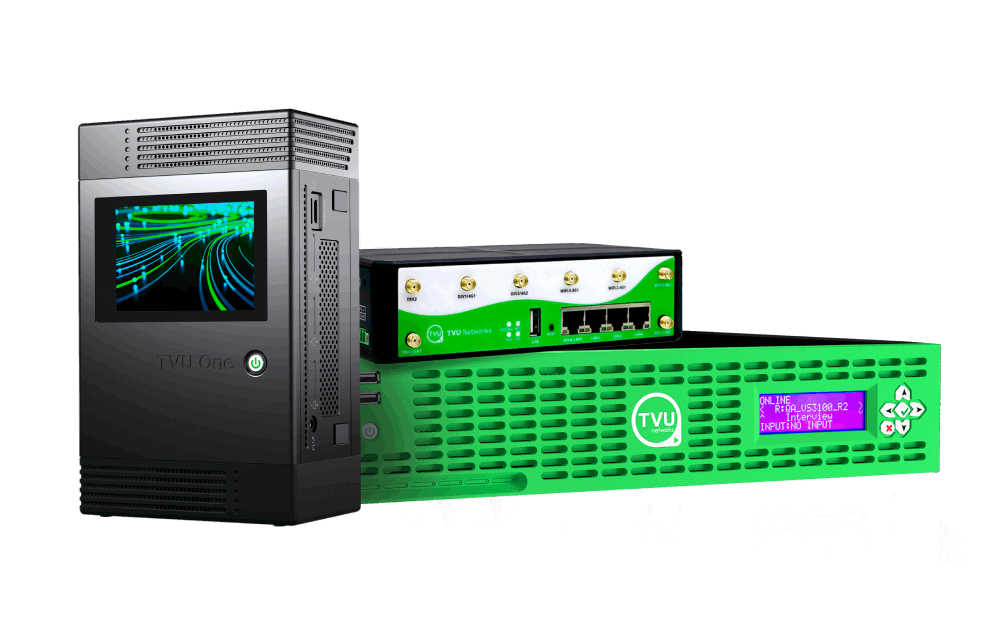
IShowSpeed doesn’t just stream. He broadcasts. And the difference isn’t just semantics — it’s the hardware and software stack running behind every chaotic, viral moment he puts out for his 44 million YouTube subscribers.
When Speed embarked on his 35-day, 24/7 cross-country livestream across the United States in September 2025, the operation behind it looked less like a typical creator setup and more like a rolling television production. At the center of it all was TVU Networks, a California-based company that has spent decades supplying broadcast technology to newsrooms and sports networks around the world.
Here’s a breakdown of exactly what TVU brought to the table.
TVU RPS One IRL Backpack
The RPS One is the hardware that makes outdoor, on-the-move streaming possible at broadcast quality. Speed’s team wore these backpacks during field segments, and they kept multiple camera feeds synced and stable even as the tour bus cut through remote locations with weak or zero fixed connectivity.
What makes it different from a standard IRL streaming backpack is its ability to bond multiple network connections simultaneously. Rather than relying on a single SIM card or Wi-Fi source, the RPS One pulls from several connections at once and intelligently distributes the data load. If one signal drops, the others compensate and the viewer never notices.
For a stream that could not afford a single dropout over 35 consecutive days, that redundancy was non-negotiable.
TVU Producer
Once the video signal leaves the backpack, it has to go somewhere useful. That’s where TVU Producer comes in. It’s a cloud-based live production platform that handled everything from live camera switching and replay management to graphics overlays and real-time collaboration across Speed’s distributed production team, all from a browser, with no dedicated hardware suite required.
This is significant. Traditional broadcast switching requires a physical production truck or control room. TVU Producer moves that entire workflow into the cloud, meaning Speed’s team could have a director managing cuts and graphics from a different city entirely, while the stream stayed live on the ground.
For creators looking to level up from basic OBS setups, this is the professional tier.
TVU ISX Transmission Algorithm
ISX is the invisible engine underneath all of it. It’s TVU’s proprietary transmission algorithm, and its job is to aggregate multiple internet sources. In Speed’s case, that meant Starlink satellite alongside 4G and 5G cellular networks, all combined into one stable, high-bandwidth pipe.
The algorithm doesn’t just combine connections. It actively manages them, prioritizing the strongest signal at any given moment and compensating in real time when conditions change. Driving through a rural stretch with no cell tower? ISX shifts more load to Starlink. Entering a dense urban area with strong 5G? It rebalances accordingly.
The result is a stream that stays clean regardless of what the road throws at it.
How It All Came Together
Speed’s tour bus was converted into a full mobile production hub, with cameras wired throughout the vehicle and TVU devices powering every feed. UnlimitedIRL, a professional live streaming solutions company, partnered with TVU on the project to handle technical deployment and on-ground integration.
Samuel I, known as Slipz, served as Speed’s technical director throughout the tour. “With TVU, we’re locked in, rock-solid tech, backup when we need it, and the freedom to push streaming further,” he said. “That’s how Speed keeps breaking the mold and delivering the kind of moments fans can’t miss.”
The collaboration represented something broader than one streamer’s tour. It signaled a convergence between traditional broadcast infrastructure and the creator economy, two worlds that, until recently, operated on entirely different budgets, toolchains, and audiences.
The Bigger Picture
TVU Networks has spent years serving CNN, BBC, and major sports leagues. The fact that the same company is now powering a YouTuber’s cross-country road trip says everything about where live media is heading.
Broadcast-grade reliability is no longer exclusive to legacy media. As the tools get more portable, more cloud-native, and increasingly affordable, the gap between a network television production and a top-tier creator stream is closing fast.
IShowSpeed just happened to close it loudest.













 and then