
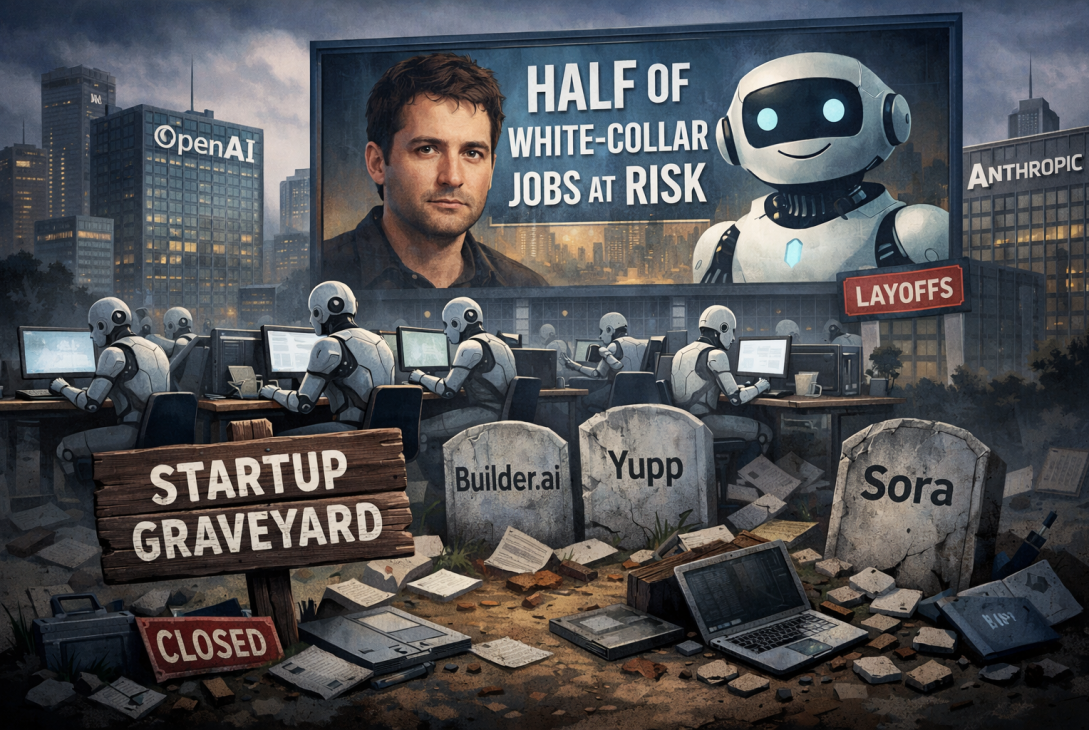
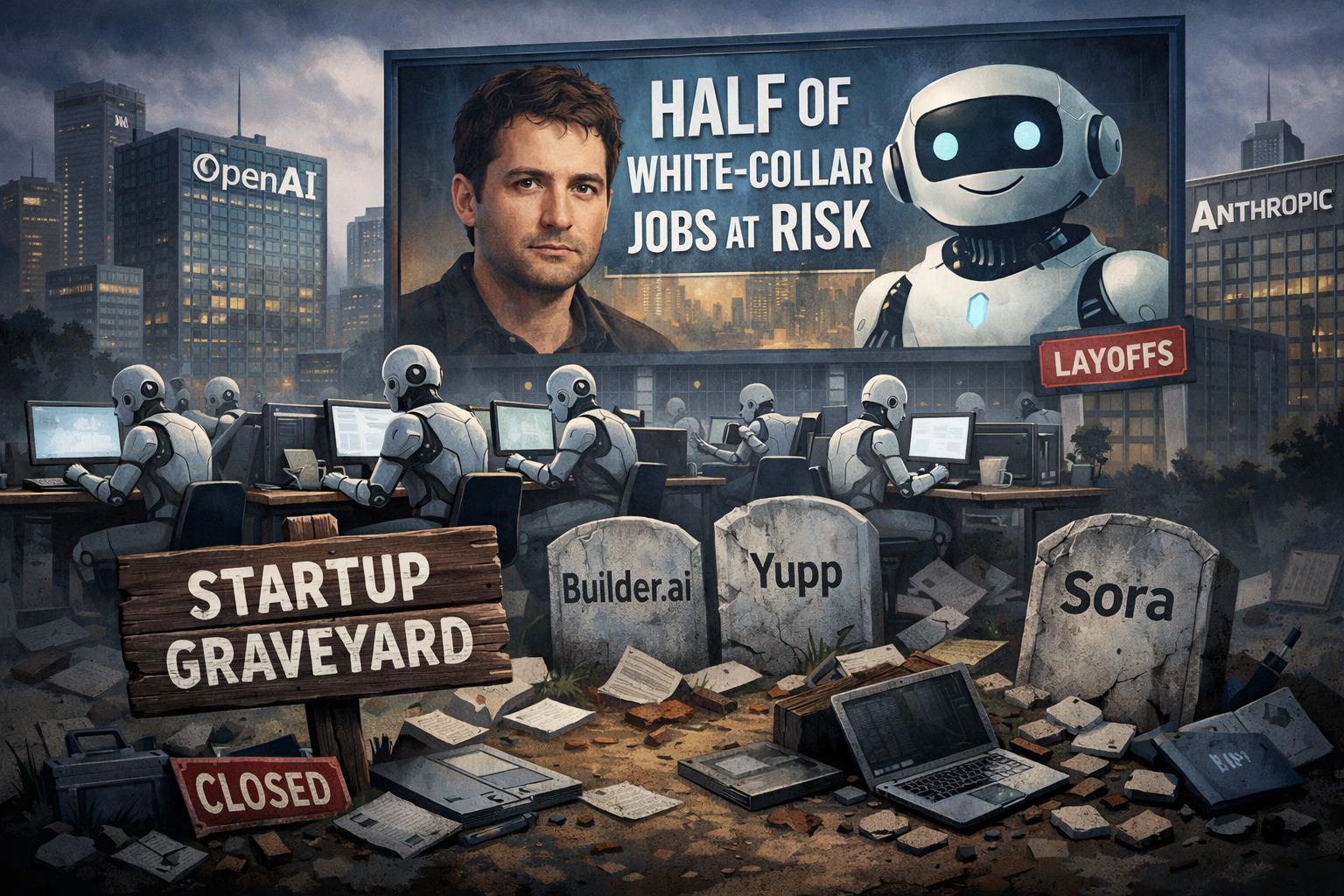
Startups are dying. Jobs are disappearing. And the company whose AI is doing a lot of the work just admitted it might wipe out half of white-collar employment.
Let’s be honest about what most “AI startups” actually were.
Someone got API access, wrapped it in a clean interface, dropped “AI-powered” into the pitch deck, and raised a seed round. The product worked, loosely. Users signed up. Screenshots made the rounds. Then OpenAI or Google shipped the same thing natively, for free, inside a product people already used, and the startup had nothing left.
That story played out hundreds of times in 2025. It is still playing out now.
SimpleClosure’s 2025 Startup Shutdowns report confirmed what most people in the industry already sensed: AI now accounts for nearly 16% of all startup closures. The companies going under are not the ones that ran out of ideas. They are the ones that built thin products on top of someone else’s model and had nothing underneath when the platform updated.
Builder.ai Was the Warning
The Microsoft-backed no-code startup raised $445 million, hit a $1.5 billion valuation, and told users they could build apps without writing a single line of code. The AI was called Natasha. What they left out was that behind Natasha, human engineers were quietly doing much of the actual work. The whole thing filed for bankruptcy in 2025.
Then there was Yupp, which raised $33 million from a16z to crowdsource feedback for AI models and shut down less than a year after launching. Dozens of smaller tools disappeared around the same time, most without a press release.
The pattern is not complicated. When your entire value proposition sits on top of someone else’s infrastructure, you are not running a company. You are running a feature that has not been built yet by the platform you depend on.
OpenAI Also Cut One of Its Own
What makes this more than a startup graveyard story is that the correction is not stopping at small companies.
On March 24, OpenAI shut down Sora. The same Sora that launched in September 2025 to enormous coverage, the one people called the “GPT moment” of AI video generation, the one that crossed a million downloads in its first ten days. Six months after launch, OpenAI killed it and sent the compute elsewhere.
The numbers behind the decision are worth sitting with. Sora’s 30-day user retention rate was 1%. Its 60-day rate was essentially zero. Monthly compute costs were running at up to $15 million. People downloaded it, generated a clip or two, and never opened it again. With an IPO on the horizon in the second half of 2026, OpenAI could not keep a $15 million monthly bill attached to a product nobody stayed around to use.
The lesson is not specific to Sora. It applies everywhere: good demos do not survive contact with actual retention data.
Claude Is Part of What Is Doing the Cutting
This is the part that tends to get buried in coverage of the AI boom.
Claude is not just competing with other AI companies. It is actively replacing roles inside the businesses that use it, and some of those businesses have been unusually direct about saying so.
In February 2026, Block CEO Jack Dorsey announced layoffs that reduced the company’s headcount from 10,000 to fewer than 6,000. His explanation, from the shareholder letter: “intelligence tools have changed what it means to build and run a company.” Block had spent 2025 integrating AI across customer service, fraud detection, and internal operations. By early 2026, those systems had matured enough that the company decided it no longer needed the people they had replaced.
Amazon eliminated roughly 30,000 corporate jobs across late 2025 and early 2026, with executives pointing to AI efficiency as the driver. Law firm Baker McKenzie cut between 600 and 1,000 employees across research, marketing, and secretarial functions, citing AI directly. Chegg, the homework-help platform, cut 45% of its workforce after students stopped paying for a service they could replicate with a chatbot for free.
Challenger, Gray and Christmas tracked the shift: 23% of Q1 2026 layoffs explicitly cite AI automation in public filings, up from 14% the previous quarter. It is accelerating.
Anthropic’s own research published this year added uncomfortable specificity to all of it. Their study on labour market exposure found AI can already handle most tasks in finance, law, management, and office administration. The workers most exposed are not junior. The most AI-threatened group earns 47% more than the average worker and is nearly four times as likely to hold a graduate degree. The lawyer. The financial analyst. The software developer.
Dario Amodei, Anthropic’s CEO, has called what is coming “unusually painful.” He has predicted AI could eliminate half of all entry-level white-collar jobs and push unemployment as high as 20% within five years. He is the person who built Claude. He is also the person saying this most clearly in public.
What Actually Survives
The money is not gone. In 2026, AI startups still capture over 50% of total global venture funding. OpenAI and Anthropic alone absorb 14% of all global investment. Capital is concentrating, not retreating, and it is moving toward companies with something proprietary that cannot be replicated by a model update.
Big tech is tightening from above. More API restrictions, tighter usage terms, and native AI embedded into every product surface. Google has AI inside every Workspace document. Microsoft has Copilot everywhere. The gap between “pay for a startup” and “just use what is already in your tools” keeps closing.
The companies holding on are not trying to beat OpenAI at general intelligence. They are building deep into a specific problem, one specific enough that a platform update will not come for them. A company embedded inside the compliance workflow of a Nigerian financial institution, trained on local regulations, integrated into daily operations, that product is not going to be replaced by a ChatGPT update. The specificity is the protection.
That is really the whole thing. Depth over breadth. Real integration over clean interfaces. Build something people would actually miss if it disappeared, not something they tolerate until something easier comes along.
The noise from the past two years is clearing. What is left are real questions. Does your product solve something specific enough to survive the next platform update? Do your users actually need you, or do they use you because nothing better has shipped yet?
For founders across the African tech ecosystem, this moment is worth paying attention to. The filter is here. It is not coming.
















 and then