
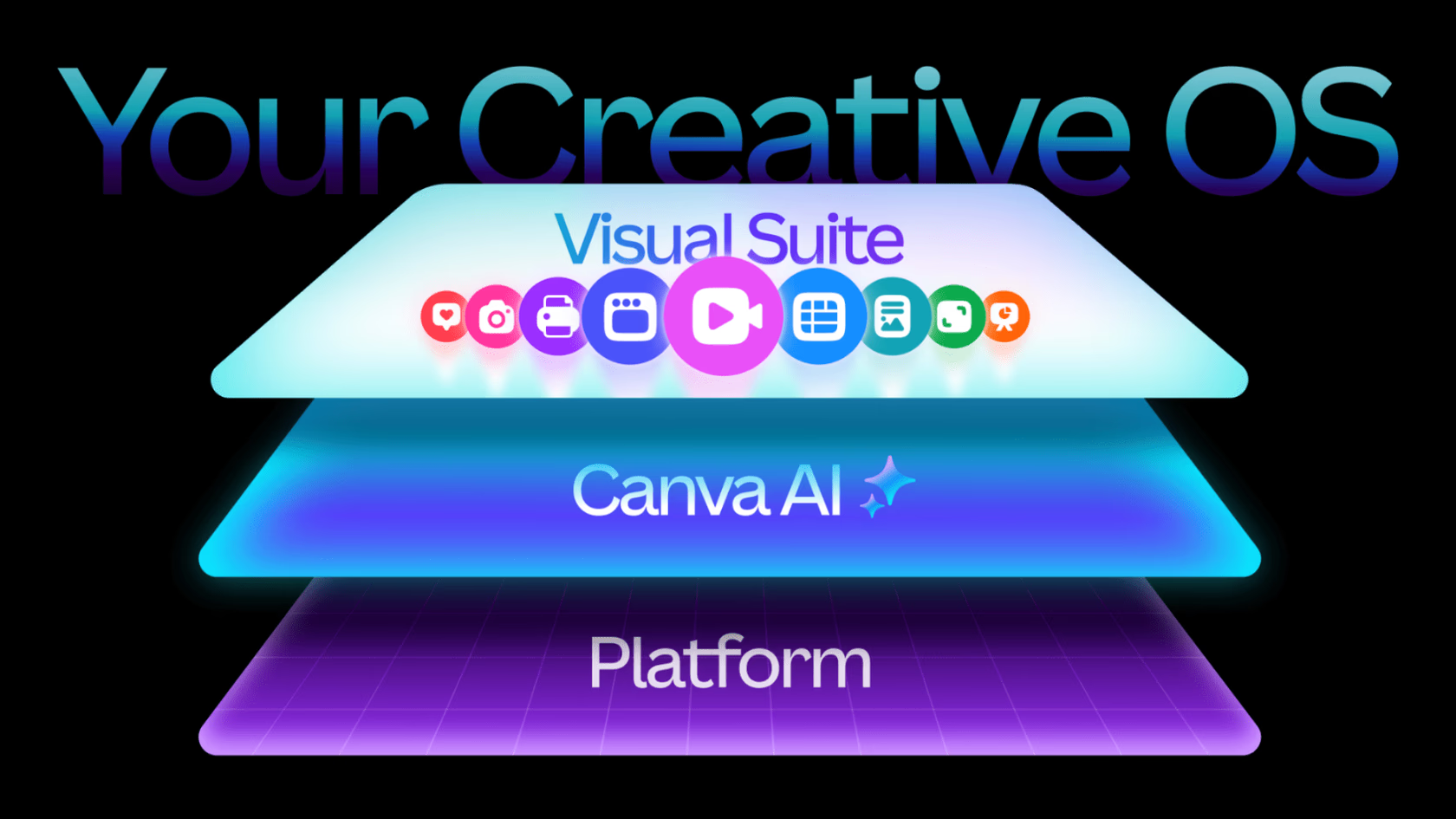
AI design model via canva.com
Canva, the Australian design software company with 260 million monthly active users and $3.5 billion in annualized revenue, announced a sweeping overhaul of its platform on Thursday, launching its own proprietary AI design model and introducing what the company calls its “Creative Operating System.” The update marks the company’s most aggressive push yet to compete with established players like Adobe Creative Cloud and Figma, combining new design capabilities, marketing tools, and professional-grade software into one integrated ecosystem.
A First-of-Its-Kind AI Design Model
At the heart of Canva’s announcement is a new foundational AI model specifically trained to understand design, a capability that sets it apart from existing generative AI models. Unlike traditional diffusion models that generate flat JPEG-style images with no editable components, Canva’s Design Model creates layered, editable designs that users can customize after they are generated.
“Design is actually quite complicated,” explained Jen Thompson, head of product marketing at Canva. “It brings together hundreds if not thousands of different elements and aspects into something that communicates a message effectively.” The company’s solution: train an AI that understands text, images, layouts, hierarchy, and brand logic rather than simply generating flat photos.
The model works seamlessly across multiple formats, including social media posts, presentations, whiteboards, and websites, enabling designers to seamlessly transition between design types without losing context or having to regenerate content from scratch.
Expanded AI Assistant and New Features
Canva is making its AI assistant available across the entire platform, including design canvases and element tabs. The expanded Canva AI now supports collaborative mentions, allowing users to tag the assistant in comments to request media or text suggestions while co-editing projects. The assistant can also generate 3D objects, replicate art styles, and provide design recommendations.
The “Ask @Canva” feature provides real-time design feedback and suggestions, allowing users to stay within their workspace and positioning the AI as a design partner rather than just a starting point for creation.
“It means that you lead the way, but AI is there to support, not just at the beginning, but all the way through, to make sure you’ve got an amazing design at the end of the day,” said Thompson.
New Products and Platform Expansions
Beyond AI features, Canva introduced several new products aimed at expanding its reach into marketing and business workflows:
Canva Forms: A new tool for collecting user input directly within Canva, positioning the platform as a competitor to Google Forms.
Email Design: Users can now create branded email templates and campaigns for marketing or transactional emails directly within Canva, eliminating the need to use specialized platforms like Mailchimp.
Canva Grow: An all-in-one marketing platform that uses AI to generate campaign ideas, create assets, publish directly to platforms like Instagram and Meta, and track performance metrics from within Canva.
Data Integration: Canva is connecting its spreadsheet product (Canva Sheets) with its coding tool, allowing users to create data-driven widgets and visualizations from their data.
Free Affinity Pro: Canva is making its professional design suite, Affinity, acquired last year to compete with Adobe, free forever for all users, while redesigning its interface to merge vector, pixel, and layout capabilities under one workspace.
Positioning Against Adobe and Industry Trends
Canva’s aggressive expansion comes as Adobe also announced AI assistant tools for Express and Photoshop this week, sparking competition in the creative software space. However, Canva’s strategy differs significantly: instead of selling a suite of separate applications, the company is building an integrated ecosystem that bridges design, data, and marketing.
Wayne Kurtzman, research vice president at IDC, praised Canva’s approach: “These announcements are designed to grow and expand paid seats for professional, organizational and individual creators alike, while retaining the ease of use across devices. Having refined the UI without creating user shock reinforces that they are definitely on the right track.”
The free Affinity move is particularly strategic, as it brings professional-grade tools to users who might have been locked into Adobe’s expensive Creative Cloud subscription model. Enterprise customers, such as LinkedIn, Stripe, and Snowflake, are already using Canva, signalling strong adoption at the organizational level.
What This Means for Creators and Businesses
Canva’s updates represent a fundamental shift in how the company positions itself: from a design tool for non-professionals to a comprehensive creative platform serving teams, marketers, and professional designers. The introduction of Canva Business—a $20-per-month plan for solopreneurs and small teams—signals expansion downward into the SMB market.
For real estate agents, social media managers, and marketing professionals, the ability to create, publish, and track campaign performance from one interface eliminates workflow fragmentation. For enterprises, integrating data visualization, collaboration tools, and brand management offers the potential to reduce tool sprawl.
The company also announced it has increased its product release pace to two major events per year, with Chief Operating Officer Cliff Obrecht noting: “With a relatively unchanged staff, we have become much more efficient.”
The Bottom Line
Canva’s announcement on October 30 represents one of the most significant product expansions in the company’s history. By launching its own AI design model, integrating marketing capabilities, and making professional tools free, Canva is no longer content to be “the design tool for non-designers.” Instead, it’s positioning itself as a full-stack creative and marketing platform capable of competing with Adobe, Figma, and specialized marketing software. Whether this ambitious expansion succeeds will likely determine Canva’s trajectory as it pursues an IPO, and whether the $3.5 billion in annualized revenue becomes the foundation for becoming a $ 10 billion or more creative technology company.


















 and then