
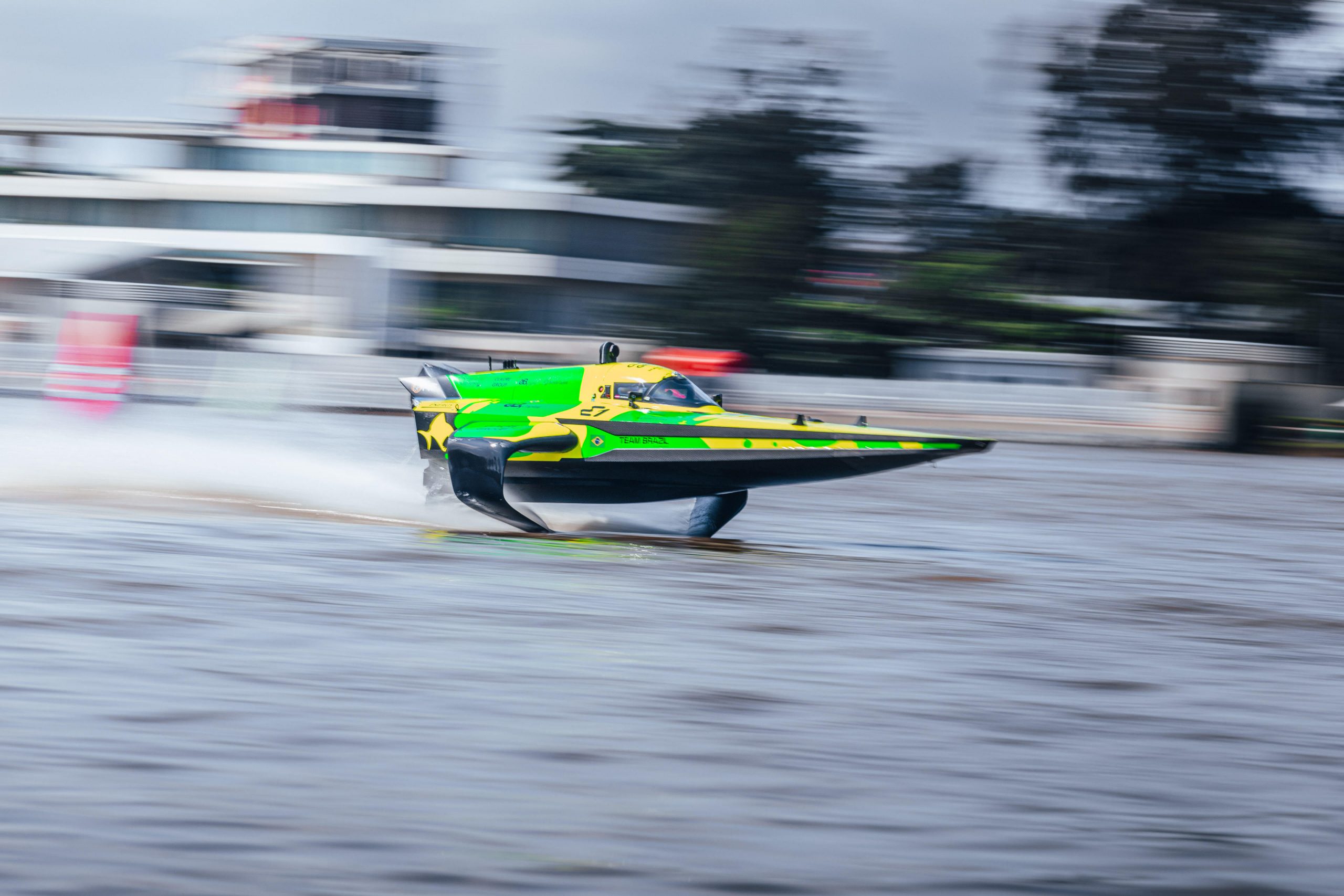
Team Brazil RaceBird electric powerboat racing on Lagos Lagoon during E1 Lagos GP 2025 at Victoria Island
The dust (or rather, spray) has settled on Lagos Lagoon after an electrifying weekend of racing at Africa’s first-ever E1 GP. The historic E1 Lagos GP, held October 4-5, 2025, and presented by FirstBank, saw Team Brazil celebrate their maiden victory as thousands of spectators packed the waterfront around Black Diamond Hotel on Victoria Island. Here are five key takeaways from the groundbreaking Lagos E1 GP that revealed much more than just who crossed the finish line first.
1. Lagos Is Ready for the Global Stage
Let’s address the elephant in the room, or rather, the RaceBird on the lagoon. Many wondered whether Lagos could pull off an event of this magnitude. The answer came back with a resounding yes.
More than 10,000 spectators turned up across multiple viewing locations, creating what E1 CEO Rodi Basso called “one of the most exciting stops on the global calendar.” The city’s infrastructure held up, the logistics at Black Diamond Hotel worked seamlessly, and the atmosphere was electric. Governor Babajide Sanwo-Olu wasn’t exaggerating when he said the event placed Lagos “alongside iconic global waterfronts like Monaco and Venice.”
This wasn’t just a one-off success either. The event demonstrated Lagos’ capacity to leverage its unique coastal geography for world-class sporting events. As Rodi Basso noted in the official media guide, “Lagos is a city defined by energy and creativity. By staging E1 here, we aim to honour that heritage and connect with communities, inspire young people through technology and sport, and leave a legacy that goes beyond the racing.”
The E1 Lagos GP attracted a who’s who of global sporting icons like football legend Didier Drogba (who owns Team Drogba Global Africa). With celebrity team owners also including Tom Brady, Rafael Nadal, Will Smith, LeBron James, Steve Aoki, and Marc Anthony, Lagos proved it could deliver the premium experience that attracts this calibre of international attention.
The lesson: Lagos has graduated from hosting regional events to being a viable destination for premium international sporting championships. The city’s “unstoppable Vibes” aren’t just marketing speak. They’re a genuine competitive advantage that can attract A-list global events.
2. The RaceBird Technology Is Revolutionary (And Ready for Prime Time)
Before Lagos, many questioned whether the E1 RaceBird (the world’s first all-electric foiling raceboat) could deliver genuine racing excitement. The weekend answered that emphatically.
These technological marvels, designed by Norwegian innovator Sophi Horne and engineered by Rodi Basso’s team, hit speeds of 93 km/h (50 knots) while literally flying above the water on hydrofoils. Powered by a 37 kWh battery with 150kW peak output (approximately 200 horsepower), the 7.5-meter boats combine cutting-edge electric propulsion with sophisticated racing dynamics.
What made E1 Lagos GP particularly compelling was watching these boats handle challenging conditions. The tropical storm that delayed Sunday’s racing tested both the technology and the pilots. When Team Brazil’s Timmy Hansen and Ieva Millere-Hagin dominated despite the tricky waters, it proved that the RaceBirds aren’t just fast in ideal conditions. They’re genuine race machines capable of handling real-world challenges.
The race format itself showcased the technology’s strategic depth. With mandatory long and short lap variations, variable boost power, and the need for precision in six-lap races, pilots couldn’t just rely on raw speed. The hydrofoil technology adds another layer: one moment of miscalculation and you’re back in the water instead of flying above it.
The lesson: Electric motorsport has matured beyond the “proof of concept” phase. The E1 RaceBird represents genuine racing technology that delivers both performance and sustainability. The 1,150kg boats running on zero-emission electric power proved that you don’t need combustion engines to create edge-of-your-seat racing drama.
3. Celebrity Ownership In the E1 Lagos GP Creates Unprecedented Global Appeal
The E1 Series has cracked a code that many racing series struggle with: how to build a truly global fanbase quickly. The answer? Get the world’s biggest sports and entertainment stars invested, literally.
Lagos showcased this brilliantly. With nine teams owned by global icons from different sports and entertainment sectors, the event naturally attracted diverse audiences. Cricket fans in India followed Virat Kohli’s Team Blue Rising. American football fans tracked Tom Brady’s Team Brady. Tennis enthusiasts cheered for Rafael Nadal’s Team Rafa. Football supporters backed Didier Drogba’s home-continent team.
This wasn’t just passive celebrity endorsement. These are active team owners making strategic decisions about their pilots and race strategies. When Drogba showed up in Lagos to support Team Drogba Global Africa (with pilots Oban Duncan and Micah Wilkinson), it brought authentic star power that money can’t buy.
The diversity of team ownership also opened doors that traditional motorsport struggles to unlock. LeBron James’ Team AlUla, Will Smith’s Westbrook Racing, Steve Aoki’s Aoki Racing Team, and Marc Anthony’s Team Miami each bring their own massive fanbases and cultural cachet to the championship.
For FirstBank and other sponsors, this formula offers incredible value: nine different celebrity brands all promoting the same event to their massive global followings.
The lesson: The future of motorsport isn’t just about the racing. It’s about crafting compelling narratives and harnessing celebrity appeal to expand beyond traditional racing audiences. E1’s model of celebrity team ownership could reshape how new racing series build their brands.
4. The E1 Lagos GP Format Rewards Consistency AND Courage
One of Lagos’ most fascinating aspects was the unique E1 race format, which creates unpredictable outcomes. Unlike traditional motorsports, where Saturday qualifying largely determines Sunday’s results, E1’s structure keeps teams on edge throughout the weekend.
Saturday’s qualifying splits teams into two groups (top five and bottom four), who race separately. The top three from the elite group earn championship points, but it’s merely setting the stage. Sunday is where things get wild.
Teams are divided into Group A and Group B for stage races. Each team must strategically deploy their two pilots across the two group stages. Winners go straight to the final. Last-place teams drop to the Place Race. Everyone else fights through the Race Off for a final chance at glory.
Then comes the crucial twist: Final 1 sets the lane order for Final 2, but only Final 2 determines the actual winner. This format meant that Team Rafa and Team Brady (the championship leaders coming into Lagos) could dominate Saturday but still miss the podium if their Sunday strategy faltered, which is precisely what happened.
Meanwhile, Team Blue Rising’s Sara Misir and John Peeters used smart pilot deployment and consistent execution to secure second place, earning them 31 points and third in the overall championship. Their methodical approach proved that in E1, patience and precision matter as much as raw speed.
The lesson: E1’s race format is a masterclass in creating sustained drama and rewarding strategic thinking. It’s not enough to be fast on Saturday. Teams must execute flawlessly across multiple races with different dynamics, making every decision count.
5. African Motorsport Has Arrived on the World Stage
Perhaps the most significant takeaway from Lagos is what it represents for African motorsport. For too long, Africa has been absent from premium international racing calendars. Lagos changed that narrative definitively.
The UIM E1 World Championship (sanctioned by the Union Internationale Motonautique, the world governing body for powerboating that the International Olympic Committee recognizes) chose Lagos as its first African host city. This wasn’t a charity selection or a PR stunt. Lagos earned its place on a calendar that includes some of the most prestigious racing venues in the world.
The event’s success wasn’t just about logistics. It was about Lagos demonstrating the passion, infrastructure, and cultural vibrancy necessary to deliver world-class sporting entertainment. The 10,000+ fans who lined the waterfront, the smooth execution by local organizers working with the Lagos State Government, and the genuine enthusiasm for the technology and competition all proved that African audiences are ready for top-tier motorsport.
Governor Sanwo-Olu’s vision of Lagos as a hub for innovation, clean energy, and sustainable development found perfect expression in the E1 Lagos GP. As he noted, “Hosting the E1 GP is not just about sport. It is about innovation, environmental responsibility, and putting Lagos on the global map for future-focused development.”
The partnership model (combining government support from Lagos State, corporate sponsorship from FirstBank and others, and international sporting organizations like E1 and UIM) created a blueprint for how Africa can attract and host major global events going forward.
The lesson: Africa is more than just a future market for motorsport. It’s a present reality. Lagos proved that African cities can deliver the complete package: world-class venues, passionate audiences, sophisticated execution, and the cultural energy that makes events truly memorable. The question now isn’t whether Africa belongs in global motorsport, but which cities will follow Lagos’ lead.
Looking Ahead: The Miami Finale and Beyond
As the championship heads to its November 7-8 finale in Biscayne Bay, Miami, the title race remains wide open. Team Brady leads the overall standings, but with Team Rafa, Aoki Racing, and Team Blue Rising all within striking distance, and Team Brazil now surging with momentum from their Lagos victory, anything is possible.
But beyond the 2025 championship, Lagos has set a new standard for what E1 events can be. The organization has ambitious expansion plans, including growing from nine to twelve teams and expanding the race calendar, while seeking €20 million in new investment toward a €500 million valuation by 2030.
More importantly, Lagos demonstrated that E1’s mission (to “protect and celebrate coastal areas” through zero-emission racing technology) resonates powerfully. The event’s coastal clean-up initiatives and mangrove restoration programs demonstrated that high-performance racing and environmental stewardship aren’t mutually exclusive.
For Lagos, the question isn’t whether E1 will return. It’s how the city can leverage this success to attract more world-class sporting events. The blueprint is there: combine government vision, corporate partnership, world-class infrastructure, and that indefinable Lagos energy that makes everything bigger, louder, and more vibrant.
As the electric RaceBirds prepare for their Miami showdown, one thing is sure: Lagos has firmly established itself as a city that embraces innovation, celebrates sustainability, and knows how to put on a show. The energy, passion, and “unstoppable Vybes of Lagos” have left an indelible mark on the E1 Series, and this may be just the beginning of Africa’s electric powerboat racing story.
Frequently Asked Questions About E1 Lagos GP 2025
What is the E1 Lagos GP? The E1 Lagos GP 2025 is Africa’s first electric powerboat racing championship, held October 4-5 on Lagos Lagoon. It’s part of the UIM E1 World Championship presented by PIF and sponsored by FirstBank, featuring nine celebrity-owned teams racing zero-emission RaceBird boats.
Who won the E1 Lagos GP 2025? Team Brazil by Claure Group won the E1 Lagos GP 2025. Pilots Timmy Hansen and Ieva Millere-Hagin secured the team’s maiden E1 victory, earning 38 championship points at Victoria Island.
What is an E1 RaceBird boat? The E1 RaceBird is the world’s first all-electric foiling raceboat, designed by Sophi Horne. It reaches speeds of 93 km/h, powered by a 37 kWh battery delivering 150kW (approximately 200 horsepower) through hydrofoil technology that lifts boats above water.
Who sponsors the E1 Lagos GP? FirstBank of Nigeria is the title sponsor of the E1 Lagos GP. The event is organized in partnership with Lagos State Government and sanctioned by the Union Internationale Motonautique (UIM).
Which celebrities own E1 racing teams? E1 teams are owned by Tom Brady, Rafael Nadal, Virat Kohli, Didier Drogba, LeBron James, Will Smith, Steve Aoki, Marcelo Claure, and Marc Anthony. Each celebrity actively participates in their team’s racing strategy.
Where was the E1 Lagos GP held? The E1 Lagos Grand Prix 2025 took place on Lagos Lagoon near Victoria Island, with the media center and facilities at Black Diamond Hotel, Lagos, Nigeria.
When is the next E1 championship race? The next and final race of the 2025 UIM E1 World Championship season is the Miami GP on November 7-8, 2025, in Biscayne Bay, Florida.
How fast do E1 RaceBird boats go? E1 RaceBird electric powerboats reach maximum speeds of 93 km/h (50 knots) while foiling above the water surface on Lagos Lagoon and other racing venues.
Is E1 racing environmentally friendly? Yes. E1 RaceBirds produce zero emissions using electric battery technology. The championship includes coastal clean-up and mangrove restoration initiatives to protect racing venues like Lagos Lagoon.
Who finished second at E1 Lagos GP 2025? Team Blue Rising (owned by Virat Kohli) finished second at the E1 Lagos GP, with Jamaican pilot Sara Misir and teammate John Peeters earning 31 championship points and moving to third in overall standings.
The UIM E1 World Championship presented by PIF concludes with the Grand Final in Miami, Florida, on November 7-8, 2025, where the inaugural E1 world champion will be crowned.












 and then