
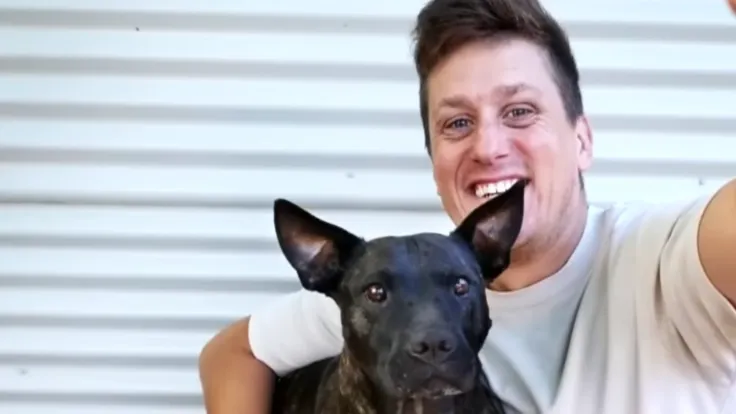
credits: YouTube: TODAY
When Paul Conyngham’s rescue dog Rosie was diagnosed with aggressive mast cell cancer in 2024, doctors gave her months to live. Chemotherapy slowed the spread. Surgery helped briefly. Nothing shrank the tumours.
So Conyngham, a 42-year-old machine learning engineer based in Sydney, did what most people with his background would eventually do: he opened ChatGPT and started asking questions.
According to Fortune, what followed over the next two months was something scientists are still processing. Working with researchers at the University of New South Wales and the University of Queensland, Conyngham designed and produced the world’s first personalised mRNA cancer vaccine for a dog. One month after Rosie’s first injection in December 2025, the tennis-ball-sized tumour on her hock had shrunk by 75%. By January, she was jumping fences at the dog park to chase rabbits.
How He Built It: ChatGPT, AlphaFold, and $3,000 Worth of DNA Sequencing
Conyngham is not a biologist. He has no medical degree. What he has is 17 years of experience in data science and machine learning, and the patience to work through gigabytes of genomic data.
His first move was straightforward: he asked ChatGPT for possible treatment directions. The chatbot suggested immunotherapy and pointed him toward genomic sequencing as a starting point. That led him to UNSW’s Ramaciotti Centre for Genomics, where he convinced Associate Professor Martin Smith, the centre’s director, to sequence Rosie’s DNA. It was an unusual request — the centre typically works with universities, not private individuals. Conyngham paid $3,000 for the sequencing out of pocket.
Once he had the data, he ran it through multiple analytical pipelines to identify the mutations driving Rosie’s tumours. He used AlphaFold, Google DeepMind’s protein-structure prediction tool, to model the mutated proteins and identify potential targets. ChatGPT helped him structure the analysis at each step. The output was a half-page mRNA sequence formula.
Professor Páll Thordarson, director of the UNSW RNA Institute, took that formula and produced the physical vaccine in under two months. Mari Maeda of the US-based Canine Cancer Alliance then connected Conyngham with Professor Rachel Allavena at the University of Queensland, who already held the ethical approvals required to administer experimental canine treatments. Conyngham drove ten hours to Gatton, Queensland, for Rosie’s first injection.
“We took her tumour, sequenced the DNA, we converted it from tissue to data, and we used that to find the problem in her DNA and then develop a cure based off that,” Conyngham told Australia’s Today programme. “ChatGPT assisted throughout that entire process.”
One week after the injection, the tumour began to visibly shrink.
What This Is — and What It Isn’t
Rosie was not cured. Conyngham has said that repeatedly, and it’s worth holding on to. Some tumours did not respond to the vaccine. He is currently sequencing those to understand why, and working on a second vaccine targeting the resistant growths.
What happened is more precise than a cure: a personalised vaccine designed around the specific mutations in one dog’s cancer produced a measurable response in under a month.
Thordarson was clear about the significance: “This is the first time a personalized cancer vaccine has been designed for a dog. This is still at the frontier of where cancer immunotherapeutics are — and ultimately, we’re going to use this for helping humans.”
The case sits alongside serious work already underway in human medicine. Moderna and Merck’s personalised mRNA cancer vaccine, mRNA-4157, showed a 49% reduction in melanoma recurrence or death in a Phase IIb trial. When approved for human use, it is expected to cost between $100,000 and $300,000 per patient. What Conyngham did for Rosie cost a fraction of that, compressed into a timeline of months rather than years.
Some scientists have pushed back on the hype. Biomedical engineer Patrick Heiser wrote on X that producing a single mRNA vaccine is technically not difficult, and cautioned that one anecdotal result in one dog proves nothing about reproducibility or safety at scale. He’s right. But that’s not quite the point being made by the people who built it.
Why Africa Should Be Paying Attention
That cost and time gap matters enormously on this continent.
Africa carries a disproportionate share of the global cancer burden while having among the least access to treatment. Cancer mortality rates across sub-Saharan Africa are significantly higher than in high-income countries, largely because patients present late and oncology infrastructure is thin. Personalised medicine — treatments designed around a specific patient’s tumour — has historically been a wealthy-country conversation. The equipment is expensive, the expertise concentrated in a handful of institutions, and the regulatory pathways long.
What Rosie’s case suggests is that the pipeline is getting shorter. AI tools handled steps that would previously have required a team of specialists and months of lab work. The sequencing cost $3,000. The mRNA vaccine was produced in under two months. The entire process moved at a speed that genomic medicine has not historically moved.
African researchers and health institutions are watching. Nigeria’s healthtech ecosystem has been building quietly, with startups working on diagnostics, remote patient monitoring, and health data infrastructure. Kenya, South Africa, and Ghana have ongoing cancer genomics research programmes. The gap between what happened in a Sydney lab and what could happen in Lagos or Nairobi is not primarily a technology gap anymore. It is an access, funding, and policy gap — and AI is compressing the technology side faster than institutions are keeping up.
The more immediate question for Nigeria and the broader continent is whether public and private health sectors will invest now in the infrastructure that makes this kind of work locally possible: genomic sequencing capacity, ethics frameworks for experimental treatment, and AI literacy in clinical settings. Conyngham demonstrated that a motivated person with the right technical background can execute a process that once required an entire research institution. That is not an argument for DIY medicine. It is an argument for institutions to move faster.
What Happens Next
Since the story broke, Conyngham has been flooded with inquiries from pet owners and patients worldwide. He has opened a Google Form for people interested in pursuing similar approaches. He is sequencing Rosie’s resistant tumours to understand what the first vaccine missed.
Martin Smith, director of the UNSW Ramaciotti Centre for Genomics, put the bigger question bluntly: “If we can do this for a dog, why aren’t we rolling this out to all humans with cancer?”
Rosie’s tumour shrank 75% in a month. That is one data point in one dog with no controlled trial behind it. But the engineers and oncologists watching this case are not thinking about one dog. They are thinking about what happens when this pipeline scales — and whether their institutions will be ready when it does.


















 and then