
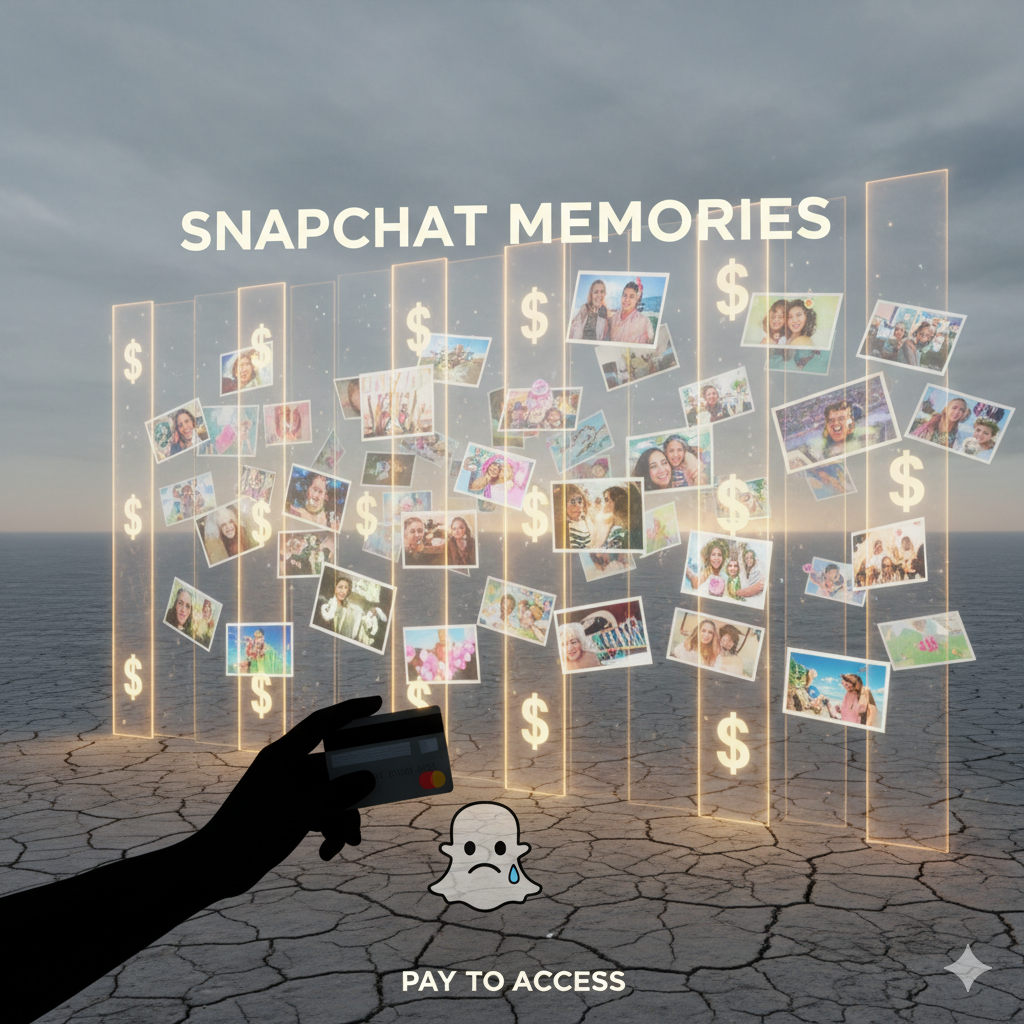
An illustration of Snapchat’s paywall interface. Image: AI-generated via Google Gemini
The era of unlimited free storage on Snapchat is officially over, and users aren’t happy about it.
After nearly a decade of letting us hoard our digital memories without consequence, Snapchat dropped a bombshell that has the internet in an uproar. The platform announced on September 26, 2025, that it’s capping free Memories storage at 5GB—and if you want to keep more than that, you’ll have to pay up. This isn’t just another app update. It’s a fundamental shift in how we think about our digital lives and who gets to charge us for them.
What’s Actually Changing?
Let’s break down what Snapchat is doing here. Since launching the Memories feature in 2016, the app has allowed users to save their snaps and stories in the cloud—completely free, with no storage limits. That was the deal. You created the memories; they were stored, and everyone was happy.
Now? Not so much.
Snap is rolling out a tiered storage system that bears a striking resemblance to what Apple and Google have been offering for years. Here’s what you’re looking at:
- Free tier: 5GB (which most users reportedly won’t exceed)
- Basic paid plan: 100GB for $1.99 per month
- Snapchat+ plan: 250GB included with the $3.99 monthly subscription
- Snapchat Platinum: A whopping 5TB for $15.99 per month
The company is at least giving users a 12-month grace period. Suppose you have already exceeded the 5GB limit. In that case, your excess memories will be stored temporarily for a year while you decide whether to pay up, download everything, or let them disappear into the digital void.
The Numbers Behind the Decision Of Snapchat Paywall
Snap isn’t making this move in a vacuum. According to their official announcement, users have saved more than one trillion Memories since 2016. That’s trillion with a T. The company admits they “never expected it to grow to what it has become today.”
And honestly? I believe them. When Memories launched, Snapchat was still primarily known for disappearing messages—the anti-permanence platform. Nobody predicted that users would turn it into a massive digital archive rivalling their phone’s camera roll.
The platform currently has 460 million daily active users and 900 million monthly active users as of the first quarter of 2025. That’s a lot of people potentially hitting that 5GB cap, even if Snap insists most users are nowhere near it.
Why Users Are Furious
The backlash has been swift and brutal. Social media lit up with reactions that ranged from disappointment to outright hostility. One viral post captured the mood perfectly: “Snapchat charging for memories like ppl even use that app anymore ”
Ouch. But they’re not wrong to be upset. Here’s why this hits different:
It feels like a bait-and-switch. For nine years, users have been told their memories are safe and free in the cloud. Now Snap is essentially saying, “Actually, about that…” People built their digital archives on the promise of free storage, and now they’re facing what feels like ransom demands for their own photos.
The timing is terrible. Let’s be real—Snapchat isn’t the cultural juggernaut it once was. TikTok and Instagram have eaten its lunch. Introducing charges for a sentimental feature when you’re trying to win users back? That’s not the move.
Users feel trapped. Once you’ve stored years of memories somewhere, moving them becomes a massive undertaking. Snap knows this. The longer you’ve been using Memories, the harder it is to walk away, which makes the whole thing feel predatory.
Social media consultant Drew Benvie told the BBC that paying for data storage on social platforms is likely becoming inevitable across the industry. But knowing it’s inevitable doesn’t make it any less frustrating when it happens to your favourite app.
The Bigger Picture: Tech’s Subscription Addiction
Here’s the thing—Snapchat isn’t alone in this. They’re just the latest company to realize that free services don’t pay the bills forever.
Google Photos ended unlimited free storage for “high quality” images back in 2021. Apple has always capped free iCloud storage at 5GB. Yahoo recently slashed its free email storage from 1TB down to 20GB. The pattern is clear: tech companies are moving away from the “growth at all costs” model and toward “actually making money from users.”
For Snap specifically, this makes business sense. The company has been under pressure to diversify its revenue beyond advertising. Subscription services like Snapchat+ and now these storage plans help reduce dependence on ad revenue—something investors love to see.
But just because it makes business sense doesn’t mean users have to like it.
What Happens If You Don’t Make a Payment?
This is where things get interesting—and potentially heartbreaking. If you’re over the 5GB limit and choose not to subscribe, Snapchat will retain your oldest Snaps that fit within the free limit and delete the more recent ones that exceed it.
Read that again. Your newest memories—potentially the most recent year or two of your life—will be the ones that get axed if you don’t pay. Your oldest snaps, from 2016 or 2017, which you might not even care about anymore, will remain safe under the 5GB cap.
The logic presumably is that your most recent stuff is what you’d pay to keep, but it also feels like a psychological pressure tactic. Pay now, or lose the memories you’re most emotionally attached to.
If you let your subscription lapse, you’ll have a 48-hour grace period to re-subscribe before Snapchat starts deleting content. Forty-eight hours. Two days to decide if your memories are worth two bucks a month.
The Gen Z Dilemma
This hits Gen Z particularly hard. For many young users, Memories contains a genuine chronicle of their lives—high school moments, college experiences, friendships, relationships. It’s not just random photos; it’s a curated collection of moments they consciously chose to preserve on a platform they trusted.
Now they’re being asked to pay rent on their own nostalgia.
As one user put it on social media: “This is how you turn loyal users into ex-users. Nobody’s paying rent for their own photos.”
Another chimed in: “Paying to store memories you already created is wild. They really said data over sentiment.”
The frustration isn’t just about money—it’s about the principle. When you create content and store it on a platform that promised to keep it safe, having that platform turn around and demand payment feels like a betrayal of trust.
What Are Your Options?
If you’re sitting on more than 5GB of Memories, you’ve got a few paths forward:
Option 1: Pay up. If Memories is genuinely valuable to you and you don’t want to deal with the hassle of moving everything, the $1.99/month plan is honestly cheaper than a coffee. For heavy users who already subscribe to Snapchat+, the 250GB is included.
Option 2: Download everything. Snapchat allows you to export all your Memories directly to your device. It’s a pain, but it’s free. Just make sure you have enough space on your phone or computer, and be prepared to spend some time organizing everything.
Option 3: Switch platforms. Google Photos, iCloud, OneDrive, and Amazon Photos all offer varying storage options. The catch? They’re all moving toward paid models too. Google Photos gives you 15GB free (shared across Gmail and Drive), while iCloud still offers only 5GB free—the same as Snapchat’s new limit.
Option 4: The nuclear option. Delete old memories you don’t need and stay under the 5GB cap. It’s free, but it requires making tough choices about what’s worth keeping.
The Industry Trend Nobody Wants to Talk About
Let’s zoom out for a second. What Snapchat is doing represents a broader shift in how tech companies operate. The era of “move fast and break things” and “growth at any cost” is over. Now it’s about profitability, shareholder returns, and sustainable business models.
Free services were never really free—they were investments in building massive user bases that could eventually be monetized. For years, we got to enjoy the benefits of that investment phase. Now we’re entering the “paying back investors” phase.
Social media consultant analysis suggests that cloud storage costs have become genuinely unsustainable for platforms at scale. When you’re storing a trillion photos and videos, the server costs add up fast. From a pure business perspective, charging heavy users makes sense.
But here’s what makes people angry: we were never told this was temporary. The implied social contract was “you create content on our platform, we provide the tools to store it.” Now companies are retroactively changing that contract, and users feel deceived.
What This Means for Digital Preservation
There’s a deeper question lurking beneath all the rage tweets and viral posts: What does it mean for digital preservation when companies can suddenly decide to charge for access to our memories?
For years, we’ve been told to trust the cloud—don’t just store everything locally, back it up online where it’s “safe.” But what happens when safe means “as long as you keep paying”?
This gets even more complicated when you consider what happens to these memories if Snap goes under or gets acquired. Your paid storage doesn’t guarantee your memories will exist in perpetuity. It just means you get to keep them as long as the company exists and honors its commitments.
The reality is that no company is obligated to store your personal data forever for free. But the sudden shift from unlimited free storage to paid tiers raises uncomfortable questions about who really owns our digital lives and what control we have over them.
The Verdict
Look, I get it from both sides. Snap needs to make money. Storing a trillion photos isn’t free. Investors want returns. All of that makes sense.
But the execution here is rough. Announcing this change after nearly a decade of unlimited storage, with relatively short notice and what feels like an aggressive deadline, was always going to generate backlash. Add in the fact that Snapchat’s cultural relevance has waned significantly, and you’ve got a recipe for PR disaster.
The comments section across social media tells the story: users feel nickel-and-dimed, taken advantage of, and frustrated by yet another subscription creeping into their lives. The phrase “paying rent on your own photos” keeps coming up, and it resonates because it captures the fundamental absurdity of the situation.
Will this kill Snapchat? Probably not. Most users are reportedly under the 5GB cap and won’t be affected. But for heavy users—the most engaged part of Snapchat’s audience—this is a moment of reckoning. Is the platform worth paying for, or is it time to take the next step?
As one social media user perfectly summarized: “Classic tech move. Build dependency, then monetize. Guess I’ll finally clean out those 2016 concert videos I never watch.”
The era of free unlimited storage on social platforms is ending, one app at a time. Snapchat is just the latest casualty—or, depending on how you look at it, the latest company to realize that free doesn’t pay the bills forever.
Either way, your move. Download those memories while you still can.
The rollout is occurring gradually across various regions, with full implementation anticipated over the coming months. Snapchat has not disclosed exact pricing for all international markets, but has confirmed the U.S. pricing structure outlined above.




















 and then