
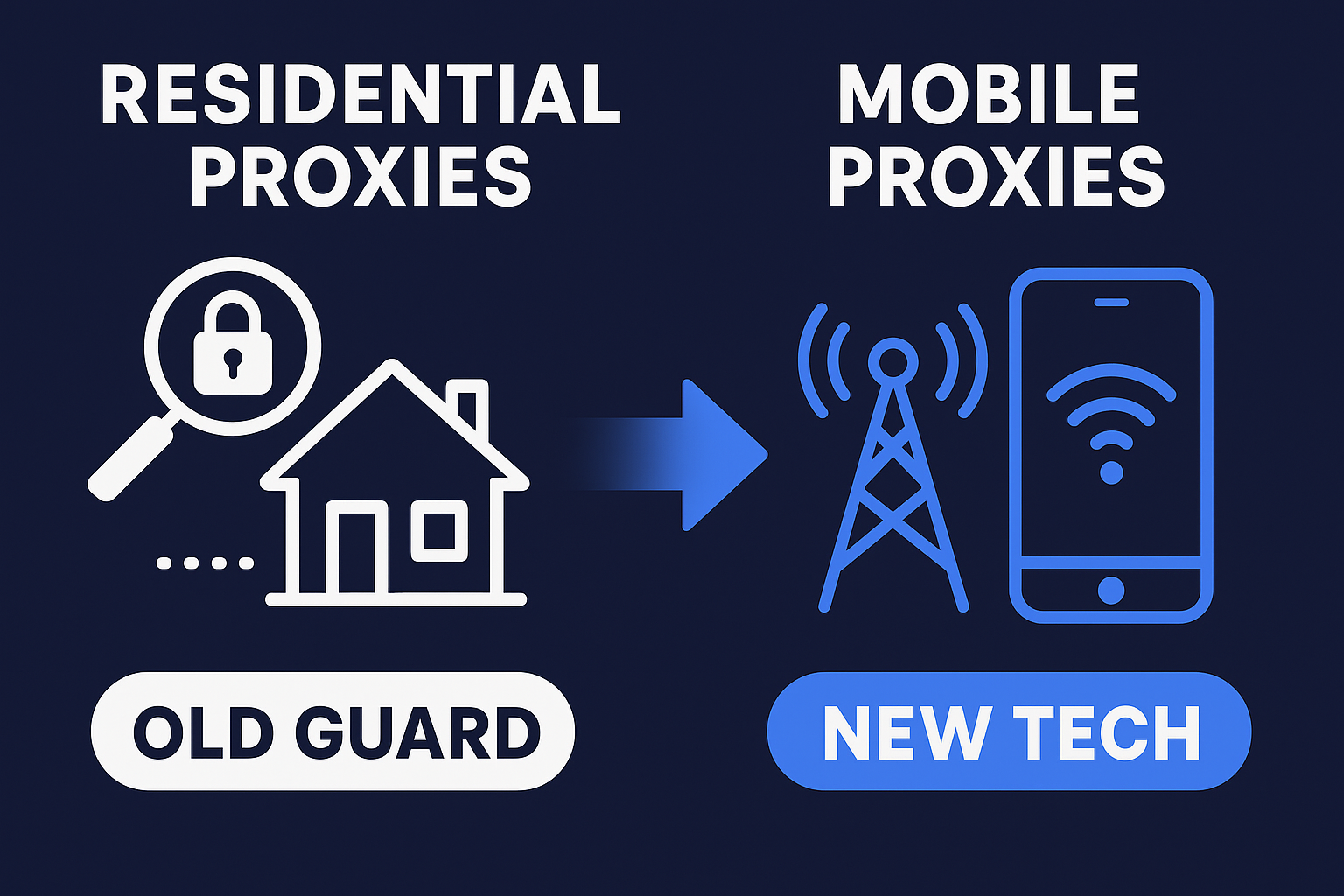
Five years ago, if you asked anyone serious about web automation what they used, the answer was always the same. Residential proxies. ISP-backed IPs that looked legitimate, didn’t get blocked, and felt like the gold standard of anonymity.
But here’s the thing. The technology that felt revolutionary then is starting to feel archaic now.
Something’s shifting in the proxy game. And if you’re still betting your entire data collection infrastructure on residential proxies in 2025, you’re quietly falling behind.
The Problem with the Old Guard
Traditional residential proxy networks were built on a simple premise: ISPs assign IP addresses to homes. Get access to those addresses, rotate through them, and you can scrape, automate, and monitor without detection. For years, this worked. It worked really well.
But every solution contains the seeds of its own obsolescence.
Here’s what nobody talks about openly: ISPs started noticing patterns. They saw the unusual traffic. They got complaints. And slowly, quietly, they began implementing CGNAT (Carrier-Grade Network Address Translation) a technology that fundamentally changes how detection works.
When major ISPs put thousands of devices behind a single gateway, something interesting happens. The traditional signatures that marked proxies as “suspicious” stop working. Suddenly, the traffic looks less like a bot and more like a thousand legitimate users in a neighborhood all doing normal things.
That’s a mobile proxy.
And it’s why enterprise teams managing data collection at scale are making the jump.
What Changed: Understanding CGNAT and Why It Matters
If you’ve never heard of CGNAT, don’t feel alone. Most people in the space don’t talk about it much, probably because it requires explaining how cellular networks actually work. But understanding it is the difference between choosing the right infrastructure and wasting money on yesterday’s solutions.
Here’s the simplified version: Traditional ISPs assign each home a public IP address. One address per household. Easy to understand, easy to manage, and increasingly easy to block at scale.
Cellular carriers, though? They work differently. They layer thousands of devices behind a single gateway. When you send traffic through a mobile connection, whether it’s a 4G LTE phone or a 5G USB modem, it routes through their network infrastructure with hundreds or thousands of other legitimate mobile users. Your traffic is naturally mixed with everyone else’s.
This creates a fundamental problem for anyone trying to block you: How do you block one user when their traffic is indistinguishable from thousands of legitimate customers?
You can’t. Not easily, anyway.
That’s the technical advantage. But here’s what matters more: enterprises realized this changes the game completely.
Why Enterprises Are Actually Making the Switch
When I started researching this shift, I expected to find it was mostly about technical superiority. Better performance, lower block rates, that sort of thing. And those factors matter. But talking to teams that actually made the switch, I found something more interesting.
It’s about trust and reliability.
A director of operations at a mid-sized data intelligence firm told me: “We spent three years optimizing our residential proxy setup. Three years. And then one morning, half our IPs were burned. Not gradually. Half of them. Our supplier’s entire pool got flagged. We lost a month of data collection.”
That’s a different kind of problem than technical performance. That’s business risk.
Mobile proxy infrastructure, by contrast, operates differently. Because cellular networks are actively used by millions of legitimate users constantly, the networks themselves have incentive to keep them running. They’re not consumer-facing proxy services that can disappear overnight or lose their entire IP pool in a detection cascade. They’re foundational infrastructure that society runs on.
When you build on that foundation, connecting through actual 4G LTE and 5G networks with distributed hardware in 50+ locations, you get something residential proxies can’t offer: stability that matches the criticality of enterprise operations.
The Real Economics of the Shift
This is where it gets interesting from a business perspective.
Residential proxies have always competed on price. “Get cheap IPs!” the marketing promised. And for years, that worked as a pitch. But cheap comes with hidden costs. You’re managing spotty reliability, constantly replacing burned IPs, dealing with inconsistent performance across geographic zones, and hoping your supplier doesn’t lose their entire network to detection algorithms.
Mobile proxy infrastructure costs more upfront. That’s the honest conversation.
But here’s what enterprises discovered: the total cost of operations is lower. You’re not replacing burned IPs constantly. You’re not losing weeks of data collection to cascading blocks. You’re not managing infrastructure fragility across multiple suppliers trying to patch together enough working IPs.
A fintech company in Lagos running compliance monitoring across African markets told me they switched specifically for this reason. “We need data collection that doesn’t fail. Residential proxies were costing us more in lost productivity than mobile infrastructure costs in premiums.”
That’s the real narrative. Not “mobile is cheap.” It’s “mobile is reliable enough that the math actually works.”
What This Means for Your Business
If you’re still operating on residential proxy infrastructure in 2025, the question isn’t whether to switch. It’s when you’ll need to, and whether you’ll do it proactively or reactively.
This isn’t about technology evangelism. It’s about market forces. Enterprises with the highest data collection requirements, the ones moving billions of operations daily across sensitive markets, are already making the transition. As they do, they’re creating a bifurcation in the market.
On one side: cost-optimized, spotty residential proxies good for small-scale projects. On the other: enterprise-grade mobile infrastructure for operations where reliability isn’t negotiable.
If your data collection touches anything genuinely important, compliance, market research, competitive analysis, real market intelligence, you’re probably in the enterprise category even if you don’t feel like it yet.
The teams that understand this are already ahead. They’ve moved their infrastructure, optimized their workflows around better reliability, and are now compressing timelines on data collection projects because they don’t need the extra buffer for “proxy failure scenarios.”
The Market’s Moving Faster Than You Think
What struck me most in researching this wasn’t the technology. It was the timing. Five years ago, mobile proxy adoption was niche, mostly used by specialists who understood the technical advantages. Two years ago, it was still considered an alternative for specific use cases.
Today? The conversations have completely shifted.
Every serious enterprise data operations team I’ve talked to in the last year has either already made the switch or has it planned for their next infrastructure cycle. Not because they were convinced by a sales pitch, but because they hit real limits with residential infrastructure and had nowhere else to go.
The market moves like this. A innovation solves a real problem. Early adopters get ahead. Late adopters get squeezed. And by the time everyone’s talking about it, the window for differentiation has already closed.
We’re at that inflection point right now with mobile proxy infrastructure.
What This Shift Means Going Forward
Here’s what I think happens next:
The residential proxy market doesn’t disappear. It becomes more specialized, good for what it’s good for (certain use cases at certain scales), but no longer the default choice for any operation that has scale and reliability requirements.
Mobile proxy infrastructure becomes the assumed choice for enterprises, the way residential proxies were five years ago. The conversation stops being “should we switch?” and becomes “which mobile infrastructure provider offers the best balance of coverage, reliability, and price for our specific use case?”
And the real winners in this transition aren’t the ones marketing loudest. They’re the ones who understood the market shift before it became obvious, built infrastructure to match enterprise expectations, and made it so easy to migrate that staying on old technology felt like friction rather than a deliberate choice.
The bottom line: Enterprise buyers aren’t switching to mobile proxy infrastructure because it’s trendy or because of technical superiority alone. They’re switching because it solves real problems that residential proxies can’t: reliability, scale, and infrastructure sustainability. If you’re responsible for data collection infrastructure at any meaningful scale, watching this transition isn’t optional anymore. It’s due diligence.
The market’s made its decision. The only question is whether you’ll move with it or fall behind.


















 and then