
Nvidia just raised the bar again. The company that has dominated the AI chip market for the past three years is now shipping its next-generation platform, Vera Rubin, and the performance gap between it and its predecessor is not a small step. It is a different league entirely.
Here is a breakdown of what Vera Rubin is, what it can do, and why the numbers matter beyond the data center.
The chip itself
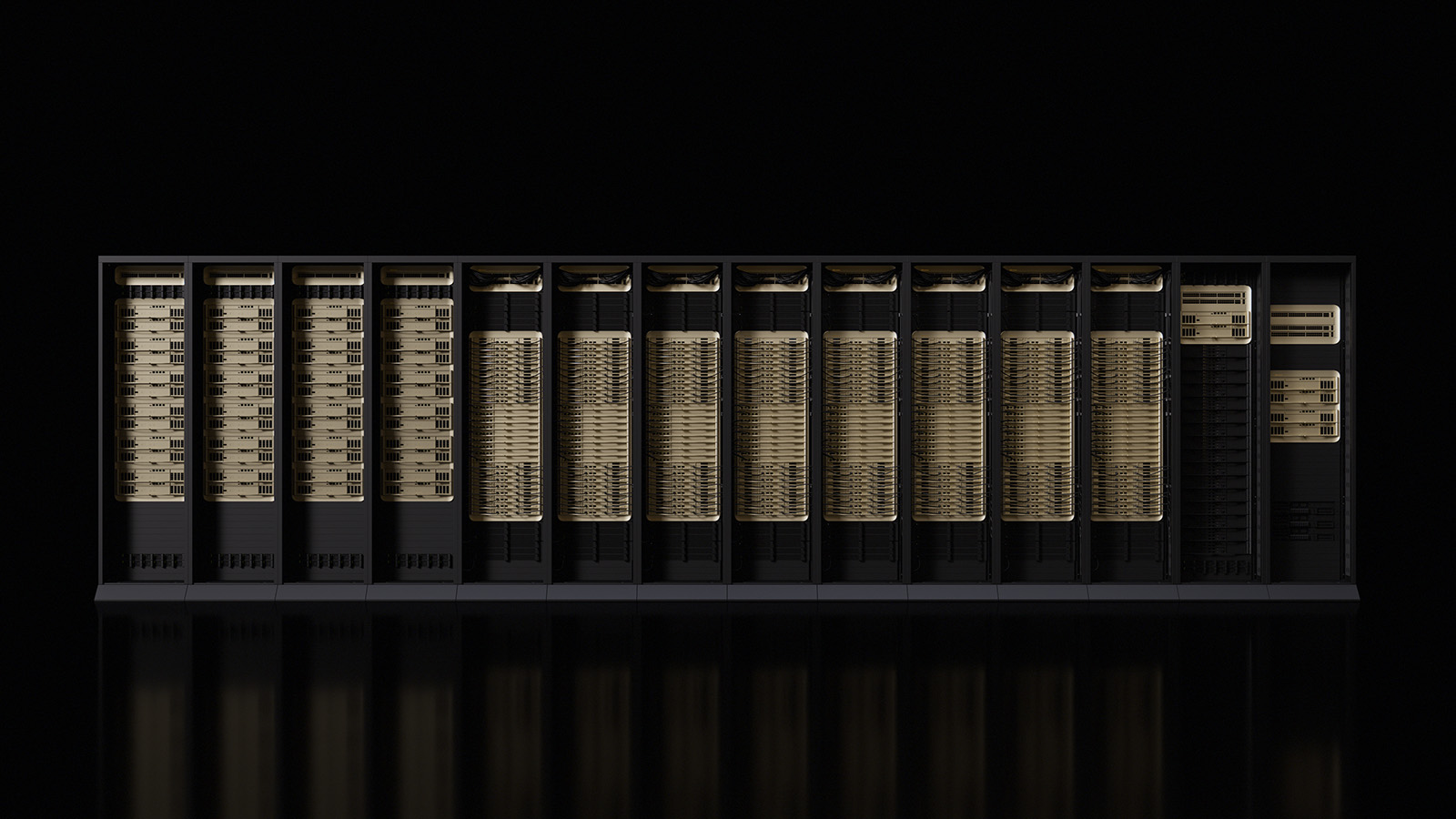
Vera Rubin is not a single chip. It is a platform built around six co-designed components: the Vera CPU, the Rubin GPU, the NVLink 6 Switch, ConnectX-9 SuperNIC, BlueField-4 DPU, and the Spectrum-6 Ethernet Switch. The headline product, the Vera Rubin Superchip, combines one Vera CPU and two Rubin GPUs into a single processor. Think of it less as a chip upgrade and more as a rethink of how compute, memory, networking, and storage are wired together inside an AI data center.
The flagship rack system, the Vera Rubin NVL72, packs 72 of those GPUs into a single liquid-cooled unit. Link several of those together and you get the DGX SuperPOD, which is what the big cloud providers are paying billions to get their hands on.
How it compares to Blackwell
This is where things get interesting. Blackwell, Nvidia’s previous generation, was already considered a significant leap over Hopper. Vera Rubin makes Blackwell look like a warm-up act.
Nvidia claims Vera Rubin delivers five times more inference performance and 3.5 times more training performance than Blackwell. It uses roughly twice the power, but here is the key figure: it delivers ten times more performance per watt. In a world where AI data centers are now competing for electricity like it is a scarce resource, that efficiency number is arguably more important than raw speed.
On the cost side, Nvidia says Rubin cuts inference token generation cost to about one-tenth of what the Blackwell platform required. That is the metric that directly impacts how much it costs to run AI applications at scale. Lower token cost means cheaper AI products, more usage, and wider deployment.
Who is actually getting it
The first wave of cloud providers set to deploy Vera Rubin-based instances includes AWS, Google Cloud, Microsoft Azure, and Oracle Cloud. Microsoft is going further, deploying Vera Rubin NVL72 rack-scale systems across its next-generation Fairwater AI superfactories. CoreWeave, Lambda, and Nscale are also among the early adopters.
The fact that every major hyperscaler is already in line says a lot about where confidence sits in this product. These are companies that have the resources to build or buy their own silicon, and several of them are doing exactly that. They are still choosing to deploy Vera Rubin.
The energy story nobody is talking about enough
Vera Rubin is 100% liquid cooled and ships with a cable-free modular tray design. That sounds like a minor logistics detail, but it is actually a meaningful shift. Easier installation, lower cooling overhead, and better power density per rack all add up when you are building data centers at the scale the AI industry now demands.
Nvidia also says the platform can move more data between connected devices than the global internet handles in the same period. That is a bold claim, but it speaks to one of the real constraints in AI at scale: moving data fast enough to keep the GPUs fed.
What this means for AI costs globally
The direct beneficiary of all these gains is not just Microsoft or Google. It is anyone who uses AI-powered software.
When training a large model costs less, and when running inference on that model costs a fraction of what it used to, those savings eventually work their way down to the products built on top of that infrastructure. API pricing drops. Consumer AI tools become cheaper to operate. Startups that previously could not afford to train or deploy competitive models get a better shot.
That is the story that gets lost in the chip launch headlines. Vera Rubin is not just a win for Nvidia’s customers at the hyperscaler level. It is infrastructure that, over time, lowers the floor for what it costs to build and use AI.
Where things stand
Vera Rubin is in full production. Partner products are expected to be widely available in the second half of 2026. Nvidia also announced a specialized variant called Rubin CPX, built specifically for million-token context processing, with 8 exaflops of compute and 100TB of fast memory in a single rack. That one targets applications like large-scale video generation and advanced coding assistants.
The chip race is not slowing down. AMD has its own rack-scale systems competing for the same customers. Google and Amazon are pushing their own custom silicon. But for now, Nvidia is shipping, the hyperscalers are deploying, and the next era of AI infrastructure has a name: Rubin.




















 and then